
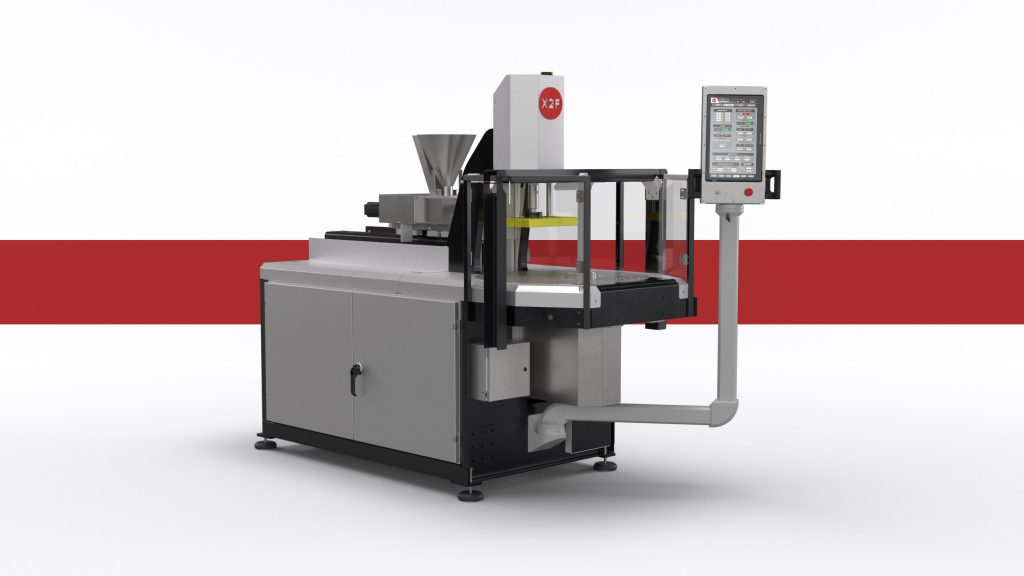
The controlled viscosity molding (CVM) technology can overmold sensitive electronics, among other applications.
Tony Deligiot – Editor-in-Chief, Plastics Technology
Published 09/16/2025
X2F is launching its latest series of machines — the E60Vi – announcing a direct-sale model for its new line of machines and establishing a partnership with a molding machine maker out of Michigan, to build the presses and securing the new line’s first orders.
To demonstrate the E60Vi’s capabilities, X2F ran a model production tool at its facility in Loveland, Colorado, this August, encapsulating printed circuit boards (PCBs) in an overmolding operation using Covestro’s TC210 material. A thermally conductive, electrically insulative polycarbonate (PC), TC210 employs mineral fillers for its thermal properties. This particular CB acts as a battery management system, controlling the charging and discharging rates. In this application, the PCB’s metal-oxide-semiconductor field-effect transistor (MOSFET), which handles power switching on these boards, can become quite hot, with the elevated temperature limiting switching speeds.
“By encapsulating with thermally conductive materials that are electrically insulative,” explains, Rick Fitzpatrick, co-founder and CTO of X2F, “we can cover the entire board, pull heat from the hot transistors and dissipate it through the mass of material covering the PCB.”
Fitzpatrick notes that conventional injection molding can’t be used to encapsulate electronics like PCBs because of the injection pressures and temperatures of the resin and mold, while X2F’s controlled viscosity molding (CVM) can be applied. “X2F enables low-velocity low-pressure flow,” Fitzpatrick says, “permitting plastic to travel farther without damaging sensitive components and unlocking new possibilities for electronic encapsulation.” In January, X2F presented its technology at Covestro’s CES booth in Las Vegas. The company will also exhibit at The Battery Show in Detroit in October, and it noted that beyond events addressing thermal management issues, it will be expanding into shows that “cover plastic molding more broadly.”
Following the August demo, X2F was going to use the new machine model to trial a customer application, which it has since won the business for. In that instance, X2F displayed the machine’s ability to fill a part with nanoscale surface features at significantly lower velocities, which was essential to avoid damaging its critical structures. The material in this case is a glass-filled engineering resin. “Conventional high-speed filling erodes these fine details due to the abrasive nature of the glass filler when cavities are filled at high velocity in conventional machines,” Fitzpatrick says.
Since the August demo X2F’s VP of Strategy and Business Development, Michael Engler, says it has secured the sale of two more “universal” or standard machines, with one to be installed domestically and the other headed to Germany. Those are in addition to more customized machines created for bespoke applications.
Going forward, X2F says that beyond electronics encapsulation, it has proven the machine in insert molding, metal injection molding, and the production of high-strength parts using long-fiber and highly filled reinforcements. The uniform material density and lack of internal stresses in the parts, minimizes sink while boosting stability and dimensional accuracy. Those benefits further open opportunities in optical components, like lenses, or other thick parts.
Decoupling Pressure From Velocity
“CVM eliminates the high-velocity shear forces common in conventional injection molding,” Fitzpatrick says. “Shear causes polymer chain disentanglement and forced alignment in the flow direction — an unnatural process that leads to anisotropic shrinkage, warping and residual stress.”
Fitzpatrick notes that CVM slows down the injection molding process to speeds and pressures that lead the uninitiated to believe cavity filling isn’t possible since material shearing isn’t happening. “By decoupling pressure from velocity, we’re able to fill slowly and deliberately — opening the door to real-time process control,” Fitzpatrick says. X2F’s lower fill velocity applies sensor feedback — in particular internal mold
cavity pressure — as the primary control metric, versus something like screw position. “When cavity pressure is held consistent,” Fitzpatrick says, “the output becomes fixed and repeatable.”
Change in Strategy
The new agreement with the machine manufacturer also marks a shift of sorts in the company’s go-to-market strategy. Whereas before it placed machines under a license agreement, which pushed it toward more complex molding materials and parts, X2F is now selling machines, enabling it to address simpler parts and materials more economically.
Regarding the vertical clamp for the new E60Vi, it’s not simply an insert molding or encapsulation play. “Think about this,” Fitzpatrick says, “in molded plastic parts, shrinkage during cooling causes the material to grip tightly onto the core, meaning most heat is extracted through the core not the cavity walls.” This means that in a horizontal clamp, process steps must occur sequentially, with adequate cooling time for part solidification and ejection lengthening the cycle.
In a vertical press with an indexing table, where the mold is configured with one top half and two bottom halves, the rules of molding can be changed, according to Fitzpatrick. Here, with the part gripping the core after filling, the cavity side can be removed quickly and the machine indexed to the second bottom core filling a second part while a robot removes the first part.
“This configuration enables multiple stages of the cycle — filling, cooling and ejection
— to run concurrently, dramatically improving throughput and overall process efficiency,” Fitzpatrick says.