
molding machines for complex applications
X2F enables manufacturers to produce highly integrated, protected components with greater efficiency and reliability.
Who we are
Headquartered in Loveland, CO, X2F designs and builds molding machines based on a breakthrough technology that leverages controlled viscosity and a patented pulse-packing process.
Our machines enable customers to mold advanced materials previously thought impossible to process, and to achieve complex geometries with greater precision and efficiency.
This disruptive approach establishes new paradigms in product design, tooling, and material science for molded parts.
Our initial focus is on applications such as:
- Over-molding of delicate components for thermal performance without aluminum.
- Motor encapsulation without potting.
- One piece flow for connectors that typically require five manufacturing steps.
- Polymer-based optics with superior optical properties
- Processing of highly filled engineering resins
To validate the technology, X2F has produced nearly three million parts across medical, industrial, automotive, and consumer electronics applications. Today, our mission is to bring this capability to the market through our commercial molding machines.
X2F is financially backed by Atlas Innovate and supported by senior advisors including former CEOs of General Motors and Dow Chemical.
our story
X2F’s Founder and Chief Technology Officer, Rick Fitzpatrick, is a veteran of the injection molding industry who deeply understands the limitations of conventional injection molding. While conventional methods are widely used and highly versatile for producing plastic parts, they do not effectively support the molding of polymers combined with fillers. This limitation restricts engineers who are working to develop next generation molded products with enhanced performance.
Attempts to mold advanced engineering polymer composites using conventional injection molding equipment often results in dramatically higher pressures, mold fill challenges, reduced tool life, and inconsistent part quality. Efforts to compensate for these issues can be costly and typically offer only limited application benefits.
Determined to find a better and more economical solution, Rick began developing X2F technology in his garage in 2010. Over a 15-year period, he machined components himself and created the unique pressure control algorithms that ultimately resulted in five patents, now registered in 18 countries. These innovations became the foundation of the X2F process as it stands today.
Rick later reconnected with his college friend Ron Leach, who was consulting for a private equity firm seeking an injection molding expert. Their shared vision and complementary expertise led them to found X2F together.
Today, X2F is bringing that original vision to life at scale. X2F technology is being applied to real world manufacturing challenges, enabling customers to mold advanced polymer composites that were previously impractical or impossible with conventional molding processes.
X2F is actively collaborating with partners across multiple industries to improve part performance, reduce manufacturing constraints, and unlock new design possibilities. What began as a garage invention has evolved into a proven manufacturing platform.
The X2F journey reflects perseverance, teamwork, and innovation. Today, X2F’s expert team continues to deliver high value solutions for industries constrained by complex material processing challenges.
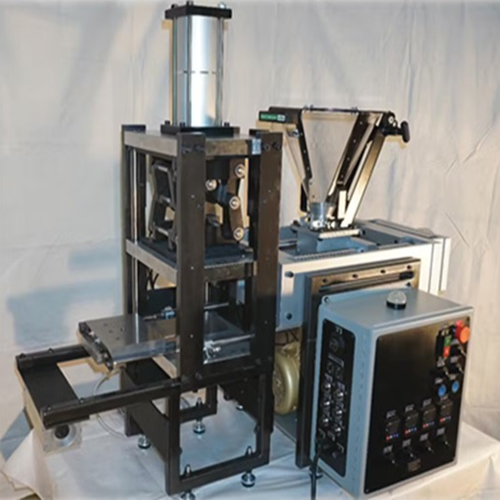
First Generation X2F Machine, 2012
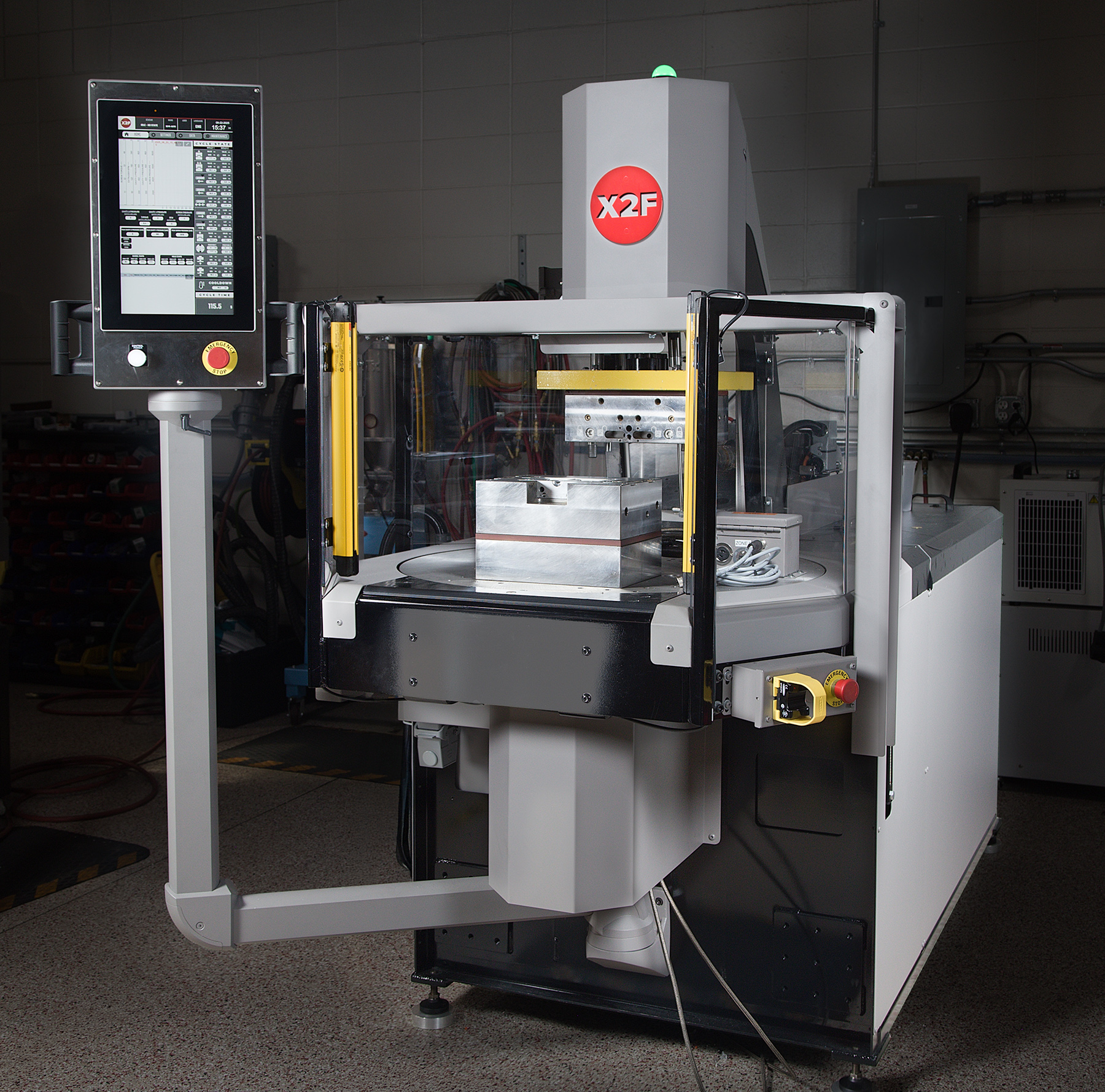
E60Vi, 2026
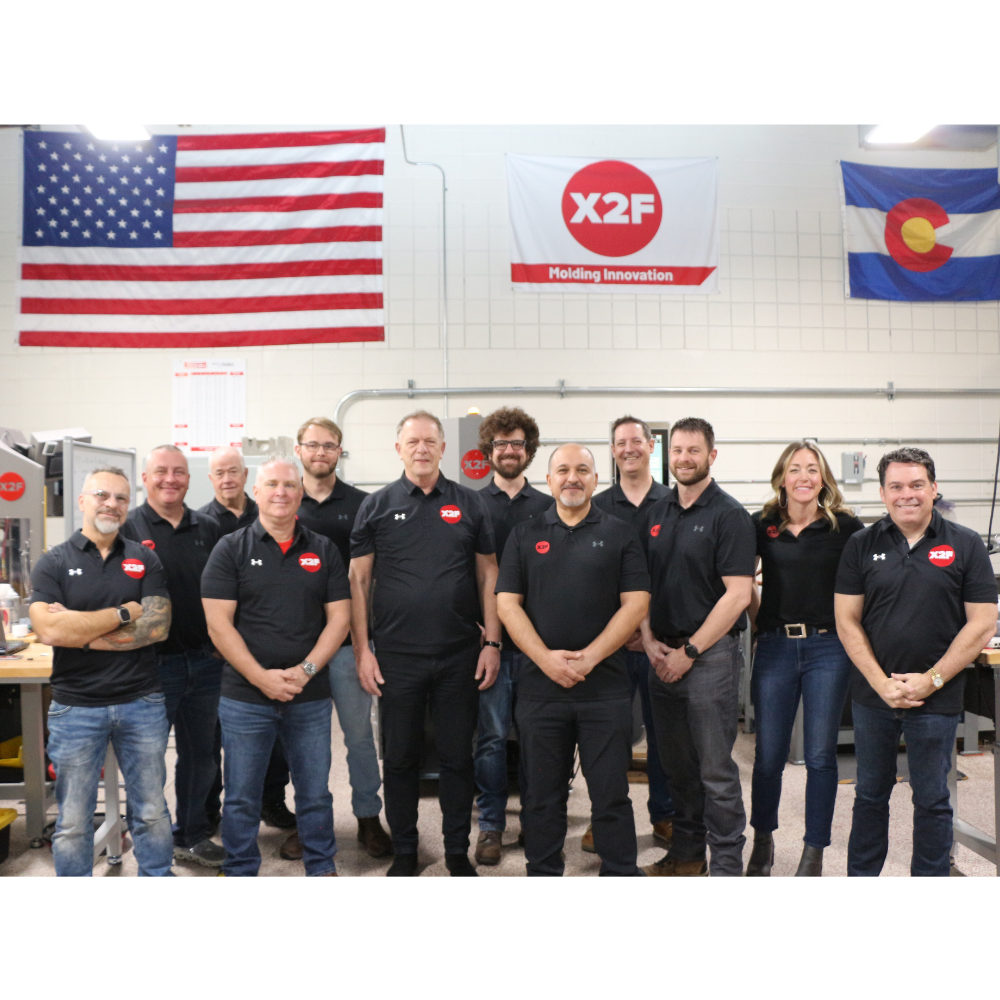
X2F Team

partners
Tradeshow / Publication Partners
Material Partners
Automation & Accessory
Industry experts
Case studIES
Case Study 1: Over-molding of Battery Management System (BMS) with KERAMOLD® 20
The power density in electronic devices is continuously increasing. This high level of generated heat and temperature requires a smart thermal transfer from the electronics to the heat sink (e.g. cooling plate or alumina housing). Next to the thermal parameters, the voltage level in many applications is also continuously increasing which means, a reliable electrical isolation between electronics and housing is crucial.
With the current solution, the BMS of a cordless screwdriver is covered by a conformal coating to protect the electronic components from dust, vibrations and ensure the electrical isolation. That solution has two main disadvantages. The first one is the thermal management, as the conformal coating is not able to transfer or at least spread the heat. The result can be “hot spots” on critical components which may lead to a failure of the whole device or at least to a forced downgrade in the power. The second topic that must be optimized is the cycling time for applying the material. The conformal coating is often a manual and time consuming production step. Together with one of the leading manufacturers of BMSs for Power Tools, KERAFOL® was working on a new solution to combine the usage of a material that can be applied by a fast automated process and being able to increase the thermal efficiency of the device.
The new developed material KERAMOLD® 20 has a thermal conductivity of 2,0 W/mK and even if the filling level is very high, the material can be processed by X2F’s low-pressure over-molding process. With that kind of injection molding process, the cycling time will be much lower in comparison to conformal coating or potting. To demonstrate the effectiveness of using the KERAMOLD® material, a thermal analysis of four different printed circuit boards (PCBs) has been done.
The test setup, test results, and PCB over-molding were provided by X2F. The X2F innovative process leverages low pressure and a patented pulse-packing method to mold parts that eliminate the constraints of traditional injection molding. X2F technology combines patented hardware, sensors, and software and is available for prototyping and full-scale production scale.
TEST SETUP
The PCBs were set up as follows:
PCB 1
This ‘baseline’ board had no over-molding material and no thermal management solution applied.
PCB 3
This board was over-molded with a thermally conductive polymer composite with filles and a thermal conductivity of 0.8 W/mK.
PCB 2
This board was over-molded by a conventional injection molding granulate without focus on thermal management by having a thermal conductivity of only 0.2 W/mK.
PCB 4
This board was over-molded by the KERAMOLD 20 that has a thermal conductivity of 2.0 W/mK.
Thermocouples were soldered to the back of each board, on the bottom-middle pad, and plugged into thermometer. A power supply was attached to each board to control current. 270mA of current was applied to each board for 10 minutes. Temperature readings were taken every 10 seconds over the 10-minute period. The temperature values were recorded graphically for each PCB tested.
TEST RESULTS
The test results shown in Graph 1 clearly demonstrate the correlation between thermal conductivity of the injection molding material and the thermal performance for PCBs.
The KERAMOLD® 20 excelled in this study, reducing PCB temperature to 45°C compared to the PCB temperature with no thermal management solutions (90°C).
CONCLUSION
The KERAMOLD® 20 is able to set new standards for Thermal Management in the field of injection molding materials.
- Improved thermal performance
- Protection against dust & humidity
- Compensation of vibrations
- Highly electrically isolating
- Saving production time in comparison to conformal coating or even potting materials
- Cost effective solution
Case Study 2: Thermal Performance of Over-molding vs. Potting Materials
METHODS
The thermal test setup consisted of a motor dynamometer (“dyno”) and thermistors inside the motor housing. The dyno applies a constant torque to the motor using an eddy current brake, and this torque is monitored using a dynamic torque sensor.
The motor is run at 1760 RPM, and once it reaches a steady speed, 1 Nm of torque is applied using the eddy current brake. This test is run until the motor reaches a steady temperature or, in some cases, when the eddy current brake exceeds its rated operating temperature of 100°C. The eddy current brake is then powered off, and the motor is allowed to continue running until it reaches a steady temperature. This test generally takes between 30 minutes and an hour to perform, exposing the motors to a realistic use cycle, with a reasonable climbing speed for half of the test, and a mostly unloaded, but still running, “downhill” section. All the motors used the same faceplate, electronics, rotors, and bearings to ensure a properly controlled test. Several motors were tested, including one without potting material (“bare”), three with solid potting (“potted”), and four with KERAMOLD® 20.
RESULTS
The following charts shows that the thermal performance of the KERAMOLD® 20 was better than the potted option, and of course way better than the bare option. In that case study, the molding process was not optimized due to cost reasons. This leads to the assumption, that the thermal performance can be still improved which will even further increase the difference to the potted material.
On average, the overmolded motors were able to maintain low temperatures longer than the potted and bare motors. Also the average time to reach 30° is much longer in comparison to the other options. This result is consistent with the expectations, as the KERAMOLD® 20 material was chosen as a possible material due to its stated superiority to the current potting material.